
What is the problem and how it began?
According to Murray Gell-Mann, one of the many characteristics of a complex system is when you have “a sequence of similar entities of increasing size and complexity, and one is interested only in how the measure behaves as the size becomes larger, then of course many of the arbitrary features become comparatively negligible”
This brings into perspective an issue that most systems are currently ongoing, where the admins worry more about the system as a whole than the parts that compose it. The network theory states the importance of the nodes/links that connect the network, and how they communicate within it. As stated by Fernando Bonilla in the government document “Regulation for Municipal Administration”, in Puerto Rico our municipalities are also called cities. Puerto Rico’s municipalities or cities could be seen as a complex network on the verge of chaos, due to the lack of communication between the links.
Interesting fact is that for a 3,515 square miles island, there are 78 cities. The amount of nodes/links that form a part of the Puerto Rico network is not only excessive but consistently reduces the interdependent relations between each municipality. The question is: how did Puerto Rico, such a small island, end with 78 municipalities/cities?
Puerto Rico became a territory of the United States after they were traded, when Spain lost the Spanish-American War in 1898. As a U.S Territory, the United States Congress delegates all of Puerto Rico’s powers, while our head of state is the President of the United States. Our government is, just as the U.S government, composed of the legislative, judicial and executive branch. The Governor heads the executive branch, the legislative branch consists of the PR Capitol/Bicameral Legislative Assembly (which is composed of a House of Representatives and Senate), and the Supreme Court of Puerto Rico heads the judicial branch.
If you were to consider the following similarities within the United States and the Puerto Rico government, you could say that we adopted the ridiculous amount of municipalities trying to copy the network system of the United States. According to Paul Ormerod, “copying has become a rational way to behave, in order to adapt”; which Mark Buchanan defines in “The Social Atom” as a characteristic of “not rational but crafty gamblers”. Puerto Ricans can be seen as crafty gamblers, copying the United States system in order to adapt to their territorial clause. The imitating atom introduced by Mark Buchanan” states how imitation is a relation that develops out of weak ties, which explains the lack of success in attempting to imitate a network system of the U.S instead of creating our own network in accordance to our size, population and government.
Puerto Rico has second-order administration division, where it’s 78 municipalities lie. In Puerto Rico, each municipality/city consists of a mayor and a municipal legislature (4 year term). Long before we became a U.S Territory, the Spaniard declared our first municipality, in 1509, and the capital of Puerto Rico, which was known as Caparra or “The City of Puerto Rico”. In 1521, Caparra was founded as the municipality/capital of San Juan. Afterwards, San German in the Southwest region was founded in 1570, followed by: Coamo in 1579, Arecibo in 1614, Aguada and Ponce in 1962. By the 19th century we had around 64 municipalities, and the last one founded was in 1971, Florida, which rounded to 78 municipalities. In 1931 Rafael Pico divided Puerto Rico into three regions, accordingly to their geographic areas: “carso norte–o”(Northern area), “interior monta–oso”(Interior Mountain area) and “llanos costare–os”(Coastal area). Below you may see a map of these regions, with their corresponding municipalities/cities.
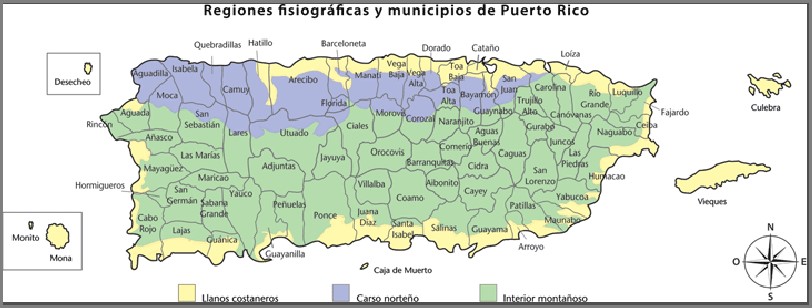
After taking a look at the map above, if you compare the size of Puerto Rico with New York State you will see the excessive amount of municipalities/cities that are a part of Puerto Rico. New York State is 54,556 square miles and has 62 cities, while Puerto Rico is 3,515 square miles and has 78 cities. What is the difference between both networks and why does Puerto Rico have so many cities? There is no absolute answer to this question; but my hypothesis is that because Puerto Rico lacks a county system, they have excessively subdivided the island in order to secure having control of all the regions without taking into account that the immense amount of subdivisions just makes this complex system a complicated one.
Lack of communication between the nodes and links
If Puerto Rico were to divide their municipalities/cities into counties this would centralize power and reduce the amount of links in the network. The other solution would be to merge municipalities and create new cities, but ego will not let this happen because those who have lived their whole life in Guaynabo would take pride in their city and not want to be merged with any other city or be named differently; but if you were to take all the cities and merge them into different counties, each city will keep their name and their pride. The only difference in being part of a county would be that operationally, things would function more effectively. Why? How can the state control and monitor 78 municipalities? Working with the Governor of Puerto Rico, Luis Fortuño gave me the insight on how municipalities don’t communicate with each other and how the state government has a difficult time trying to monitor their transactions and projects.
Before giving examples of the loopholes in the municipal system, I want to talk about what created those loopholes between the cities themselves, and between the cities and the state government. As I’ve said previously, these loopholes are due to excessive nodes/links. In “Making Things Work”, Yaneer Bar-Yam defines a network system as a set of nodes, and the links and connections between the nodes. In a complex system such as a network, you have a set of agents (nodes) and links (interaction of nodes) that constantly adapt and co-evolved accordingly to the emergence and epistasis of the network itself. An example of a system that has loopholes due to excessive nodes/links is the education system. Bar-Yam presents how the education system is remarkably distributed and has very weak interdependencies, where if a dramatic event happened in one classroom it would have little if any change on the other classroom. This is a parallel characteristic that the Puerto Rico municipal system has, where if a dramatic event takes place in one municipality it might not even affect the other one due to its weak interdependencies, which in the long run incentivize competition between them.
The Municipal Autonomy Law and the current municipal debt-crisis
When talking about the lack of communication between the municipalities/cities themselves and the central government, we have to take into account the law created, in 1991, for Autonomous municipalities. This Municipal Autonomy Law determined if municipalities were autonomous by the amount of population and the impact they had in the central government and economy. This law gives autonomous municipalities the right to do many things where there is no central government intervention. Initially, when this was created it had the purpose of facilitating economic development in these autonomous municipalities. Nowadays I feel this purpose often misused. In Article 1, Section 002 of this law it states the following:
“This Municipal Autonomy Law of the Puerto Rico ELA (Free Associated State in English) creates the mechanisms for the municipalities to have powers and faculties that are essential for an effective democratic functioning government; powers and faculties which before this law resided only in the central government. This Transfer of powers with the reduction of the central government’s intervention in municipal issues and the amplification of the acting power in areas where the municipality was very limited, will lead to a municipal reform which will redefine the municipal government, and therefore, a restructuring of the central government leading to a more democratic political process where the citizens are guaranteed an effective and responsive government according to their aspirations and needs”.
After reading this extract of the Article I, Section 002 of the Municipal Autonomy Law, we could interpret that this is one of the sources that leads to the miscommunication problem between the central government and municipalities. Not only did this Autonomy Law redefined the municipal government, but also it involves the restructuring of the central government leading to a more “democratic political process”. What is so democratic about having only 8 municipalities with these special treatments (Aguadilla, Bayamon, Caguas, Carolina, Cidra, Guaynabo, Humacao, and Ponce)?
Following the complexity theory, municipal autonomy is basically creating a whole new node between the municipalities themselves, and between municipality and the central government. An issue that the Secretary of the PR Justice Department is investigating developed due to the fact that municipalities are feeling the autonomy to do what they want, and those who are not autonomous feel disconnected from this new node; in this case, you have 19 municipalities where their mayors raised their salaries without taking into account the parameters. Within these 19 municipalities, you have municipalities that are autonomous and others that are not which are: Arroyo, Barranquitas, Cabo Rojo, Canóvanas, Cayey, Cidra, Corozal, Culebra, Hatillo, Juana D’az, Lares, Mayaguez, Orocovis, Guayanilla, R’o Grande, Santa Isabel, Vega Alta, Vega Baja, and Villalba. These smaller non-autonomous municipalities are claiming the right to have a more “democratic political process”, just as the other municipal autonomies enjoy.
The Secretary of the PR Justice Department, Sanchez Betances, went over the seven points established by the Municipal Autonomy Law which should serve as a guide for when municipal legislatures are determining the approval of salary raises for mayors; these seven points are:
- Single audit
- The amount of population and the increase in community services
- Complying with fiscal and administrative controls established by the Commissioner of Municipal Affairs’ office, the Comptroller’s office and the Federal Government.
- The complexity of the tasks and responsibilities of the Executive.
- The cost of living according to the information provided by the Planning Board, regarding the Municipal Legislature’s petition.
- The ability to attract capital and economic development to the respective municipality.
- Take into account the accrued salaries by members of the Legislative Assembly and the Secretaries of the Constitutional Cabinet.
From a fiscal management perspective, these points make complete sense, as you need to have a margin of profit within the municipality that can be assigned for the mayor’s salary. If the municipality itself isn’t generating profits or managing correctly its finances then the mayor can’t raise his salary, as it will lead to shortage in the municipality’s finances. There are currently 40 municipalities from the 78 municipalities that are insolvent in Puerto Rico. The source of this fiscal mismanagement in the Puerto Rican municipalities is due to the lack of communication between the central government and the municipalities/cities, which has been increasing ever since the Municipal Autonomy Law was created in 1991. Just the simple fact that the mayors can increase their salaries without the knowledge of the central government is utterly terrifying; specially taking into account the current debt crisis Puerto Rico.
According to the New York Times, Puerto Rico’s crisis is being compared to Detroit’s crisis:
“While Detroit has preoccupied Americans with its record-breaking municipal bankruptcy, another public finance crisis on a potentially greater scale has been developing off most Americans’ radar screens, in Puerto Rico.”
It is alarming to see how much mismanagement takes place in the municipalities of Puerto Rico. Having almost 40 of your 78 municipalities translate to more than 50% of your municipalities and government in debt. In Investment News, they stated how:
“Puerto Rico and its municipalities can’t file for Chapter 9 bankruptcy. That option exists only for municipalities located in a state that allows for muni bankruptcy filings. A state can’t declare itself bankrupt, and neither can the municipalities of any U.S. territory”.
So not only do we have a municipal/city debt-crisis, but we can’t file for Chapter 9 bankruptcy. How come? The unexplainable status of Puerto Rico should be to blame. It is a fact that Puerto Rico is a commonwealth, whatever that means. We are associated to the United States for some things, but for others we are considered free. In this case, regarding municipal bankruptcies we are free to do what we want as the United States is not responsible for our mismanagement. But then, you think of all the 100,000 Puerto Ricans that fight for the American country and you begin to understand the hypocrisy and irony with this relationship; This relationship could be seen like a bad friendship where when the U.S. wants P.R’s help they are there to defend them against other countries, but when P.R needs the U.S. to give them a lift because they are down, the U.S. indirectly blows them off. This is just a symbolic representation of the relationship between the U.S. and P.R, which explains why Puerto Rican municipalities are treated differently (not being able to file Chapter 9 bankruptcy). The territorial status is very vague; this is why the relationship between the U.S. and P.R. is so hard to understand. So if municipalities are having a hard time finding help from the federal government, how do they do to solve their current issues? This is where game theory takes effect; it’s every municipality for itself.
Game theory between municipalities
Taking into perspective the definition of epistasis presented by Hilton Root in Dynamic Among Nations, the emergence of game theory/competition within the agents or municipalities of Puerto Rico has created an epistasis, which is a change that occurs when one or more agents modify the behavior of another agent. The current municipality debt-crisis is an epistasis, where these agents are changing their strategies and behavior due to an external or environmental factor.
Instead of the municipalities collaborating together for the benefit of the system as a whole, they are competing against each other through strategic interactions in order to get the bigger profit. This is economically affecting the functionality of the Puerto Rico government. Game theory is the study of the ways in which strategic interactions among economic agents produce outcomes with respect to the preferences (or utilities) of those agents. A game is when one agent acts to maximize his utility through anticipating the responses other agents will have regarding his actions. According to Don Ross, if all agents have optimal actions regardless of what the others do, as in purely parametric situations or conditions of monopoly or perfect competition we can model this without appeal to game theory; otherwise, we need it.
Puerto Rico municipal network is not a monopoly or a perfect competition; therefore it consists of constant gaming between the different municipalities. This is usually the case in federal grants, where the municipalities instead of creating partnerships and collaborating to write a proposal for mutual benefits they decide to write separate proposals in order to maximize their profit. What municipalities don’t know is that when submitting a proposal for a federal grant, agencies are looking for projects that will impact a substantial amount of people where the larger your target population the better; making sure the size of the target population is reasonable and feasible. For example, if you have Carolina (172,728 population), Trujillo Alto (73,718 population) and Canóvanas (48,105 population) each presenting a different proposal the chances they will get the award are slim to none; but if you have Trujillo Alto, Carolina and Canóvanas partner and collaborate on a proposal it will increase the target population to 294,551 (meaning it will have a big impact) and it will have more chances of winning the award. This is an example of Game theory where agents can collaborate and profit, which will create an epistasis in the effectiveness of the Puerto Rico municipal network.
Behavior, such as the one mentioned above, will have an impact in Barabasi’s fitness model, which is the quantitative measure of a node`s ability to stay in front of the competition. Instead of having certain municipalities exceeding and the rest fighting to stay economically competitive, you merge the different municipalities into counties, according to their unemployment rate, their population and their geographic location; thus creating a fairer competitive system that reduces the fitness advantage or disadvantage that one municipality may have over another.
Concluding with a proposal for a more centralized municipal network
I am proposing a re-structuration within the Puerto Rico municipal network where the nodes/links are merged into counties. If Puerto Rico developed their municipal network into a more centralized network it will be not only more efficient, but resilient. I studied each municipality’s unemployment rate, geographic area, market, and population (in appendix) and according to their characteristics I merged them into 12 counties, which for the moment I will name as variables: A, B, C, D, E, F, G, H, I, J, K and L. In the Table below you will see the different set of counties I created with the total population and unemployment rate included.
| Counties | Municipalities | Total Population | Unemployment Rate |
| A | Humacao | 57,693 | 19.2 |
| Luquillo | 19,957 | 17.5 | |
| Fajardo | 35,766 | 14.8 | |
| Ceiba | 13,202 | 16.2 | |
| Naguabo | 27,150 | 17.6 | |
| Rio Grande | 54,030 | 13.4 | |
| Culebra | 1,806 | 7.5 | |
| Vieques | 9,262 | 12.5 | |
| Loiza | 29,681 | 16.5 | |
| Yabucoa | 37,204 | 22.4 | |
| Total | 285,751 | 15.76 | |
| B | (Capital of P.R.) San Juan | 382,299 | 9.5 |
| Total | 382.299 | 9.5 | |
| C | Bayamon | 202,325 | 11 |
| Guaynabo | 96,226 | 8.2 | |
| Catano | 27,412 | 13.9 | |
| Total | 325,963 | 11.03 | |
| D | Canovanas | 294,551 | 14.8 |
| Carolina | 172,728 | 10.4 | |
| Trujillo Alto | 73,718 | 9 | |
| Total | 294,551 | 11.4 | |
| E | Aguas Buenas | 28,239 | 15 |
| Comerio | 20,669 | 22.3 | |
| Cidra | 43,148 | 16.5 | |
| Cayey | 47,631 | 16.6 | |
| Aibonito | 25,459 | 19.1 | |
| Maunabo | 11,998 | 22.2 | |
| Patillas | 18,897 | 20.9 | |
| Arroyo | 19,433 | 20 | |
| Guayama | 44,989 | 18.4 | |
| Salinas | 30,738 | 22.4 | |
| Total | 291,201 | 19.3 | |
| F | Toa Baja | 87,582 | 11 |
| Toa Alta | 75,434 | 10.5 | |
| Corozal | 36,766 | 15.8 | |
| Naranjito | 30,315 | 15.8 | |
| Barranquitas | 30,360 | 17.8 | |
| Dorado | 38,635 | 10.5 | |
| Orocovis | 23,090 | 27.2 | |
| Total | 322,182 | 15.51 | |
| G | Gurabo | 46,935 | 12 |
| Juncos | 40,667 | 16.1 | |
| San Lorenzo | 40,627 | 15.3 | |
| Las Piedras | 39,145 | 19.6 | |
| Caguas | 141,392 | 13.2 | |
| Total | 308,766 | 15.24 | |
| H | Coamo | 40,923 | 19.1 |
| Santa Isabel | 23,344 | 17.5 | |
| Villalba | 25,396 | 17.7 | |
| Juana Diaz | 50,336 | 14.9 | |
| Ponce | 160,322 | 12.9 | |
| Total | 300,321 | 16.42 | |
| I | Vega Baja | 58,346 | 13.1 |
| Vega Alta | 39,937 | 12.7 | |
| Manati | 43,257 | 14.8 | |
| Barceloneta | 25,080 | 16.3 | |
| Ciales | 18,335 | 20.5 | |
| Florida | 12,593 | 17.7 | |
| Morovis | 32,821 | 18.9 | |
| Jayuya | 16,327 | 17.7 | |
| Utuado | 32,133 | 17.9 | |
| Total | 298,381 | 16.62 | |
| J | Penuelas | 23,500 | 15.8 |
| Guayanilla | 20,982 | 16.5 | |
| Lajas | 25,305 | 15 | |
| Yauco | 40,657 | 14.8 | |
| Sabana Grande | 24,877 | 15.3 | |
| Guanica | 18,774 | 18.4 | |
| San German | 34,885 | 14.8 | |
| Cabo Rojo | 51,115 | 10.7 | |
| Hormigueros | 17,168 | 13.2 | |
| Maricao | 6,189 | 21.1 | |
| Total | 263,452 | 15.56 | |
| K | Aguadilla | 59,400 | 14.2 |
| Isabela | 45,373 | 13.8 | |
| Quebradillas | 25,743 | 13.7 | |
| Camuy | 34,748 | 12.4 | |
| Hatillo | 42,192 | 14.2 | |
| Arecibo | 94,658 | 13.6 | |
| Total | 302,114 | 13.65 | |
| L | Rincon | 15,146 | 13.9 |
| Lares | 29,681 | 13.3 | |
| Aguada | 41,486 | 15.1 | |
| Anasco | 29,166 | 13.5 | |
| Mayaguez | 86,034 | 14.5 | |
| Moca | 39,747 | 14.2 | |
| San Sebastian | 41,543 | 16.1 | |
| Las Marias | 9,574 | 12.1 | |
| Total | 262,696 | 14.08 | |
As you may see in the previous table, most of the counties’ characteristics resulted in similar total populations and unemployment rates, which will give an equal participation to all municipalities in the economy; reducing the existent loopholes in the nodes/links of the municipal network and making the system, as a whole, economically efficient. How will this bring economic efficiency? Taking into account that the municipalities will have to collaborate with each other to maintain a sustainable county, there will be an equitable use of resources within them which will lead to less advantages or disadvantages, as seen in the fitness model. Below is a map with the counties in order to appreciate the geographic areas.
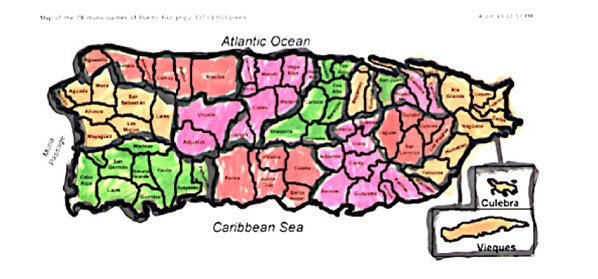
Each county will be led by a non-political director, which will reduce the amount of links that take to communicate something from the municipal to the state level, and by not being a political appointee it will help prevent any uncertainty within the government and outsider investors. Also, the creation of these counties will reduce the power and salaries of 78 mayors, and create a fiscal oversight Executive Board that will be assigned by the central government to monitor and oversight these municipalities management. This Executive Board will be composed of all the non-political County Directors. The County Directors’ Executive Board will have to meet once a month to provide updates. Each County Director has:
- As a task to monitor daily the finances of each municipality that is assigned in their county.
- Will be the leader of a County team that will be assigned to help the County Director with the oversight and monitoring of the municipalities.
- The team will be composed of people with fiscal management, investing, auditing and other financial experience.
- The amount of people that will compose each of the 12 County teams will be determine by the central government, once the reduction of the municipal government has taken effect.
- The County Director is a non-political position therefore he will not run for election, but will serve as a government contractor.
In order to create the County System, the municipal government will have to go through a restructuring phase. You will have to reduce the amount of municipal employees, which will be determined by the Central Government. As well, the mayors will have to reduce their salaries as the role they have in the municipality will be reduced, as the mayor will pass along some of his responsibilities to the County Director according to what the Central Government determined. In order to prevent ego problems, they will still be called mayors but they will have to report to the County Director, which will be the immediate contact and representative of that County to the central government. This way the mayor can focus more on their individual municipality without having to worry about what other municipalities are doing; that will be the task of the County Director, which will have to supervise and monitor the activities of the different municipalities within the county and compare them to the activity on-going in other counties.
With this County System, not only have you reduced links and nodes between the central government and its municipalities, but also you have developed a whole new fiscal management authority for the municipalities. You have created a mechanism where the disadvantaged and advantaged municipalities can work together to solve this debt-crisis and get Puerto Rico back a phase of economic development.
As Bar-Yam states, “to solve complex problems we must create effective complex organization; and where there is a constructive nature of both competition and cooperation” which is what I’m proposing as a solution to the complicated PR municipal network system, by creating a comprehensive county organization system within the municipal network reducing 78 nodes/links to 12 nodes/links.
Copyright © 2015 Capital Social LLC
Reference Guide
Ross, Don. «Game Theory». The Stanford Encyclopedia of Philosophy, Winter 2012 Edition. http://plato.stanford.edu/archives/win2012/entries/game theory/
Anom. “Regiones geográficas: Dos Lagos”. (2012).
http://eleuthare.com/wpcontent/uploads/2012/02/RegionesR%C3%ADosLagosClima.pdf
Garret, Sam. “Political Status of Puerto Rico: Options for Congress”. Congressional Research Service, no. 7-5700 (2001). http://www.fas.org/sgp/crs/row/RL32933.pdf
Buchanan, Mark. The Social Atom: Why the rich get richer, cheaters get caught, and your neighbor usually looks like you, no.1 (2007). 50-120..
Barabasi, Albert-Laszlo. Linked: How Everything is Connected to Everything Else and What it means for Business, Science, and Everyday Life, no.1 (2003). 60-109.
Bar-Yam, Yaneer. Making Things Work: Solving Complex Problems in a Complex World, no.1 (2004). 34-261.
Gell-Mann, Murray. What is Complexity, no. 1 (1995).
Ormerod, Paul. Positive Linking: How Networks can revolutionize the World, no.1 (2012). 191-197.
Bonilla, Fernando. “Reglamento para la administración municipal”, nœm.7539 (2008). http://www2.pr.gov/agencias/ocam/Documents/Reglamentos/7539REGLAMENTO%20P ARA%20LA%20ADMINISTRACION%20MUNICIPAL.pdf
Root, Hilton. Dynamics Among Nations. Mapping the Concepts: Translating Complexity to Social Systems. MIT Press, no.1 (2014).
Walsh, Mary Williams. The New York Times, Restructuring and Bankruptcy: Worsening Debt Crisis Threatens Puerto Rico. (2013).http://dealbook.nytimes.com/2013/10/07/worseningdebt-crisis-threatens-puerto-rico/? r=0
Loughran, Doug. Investment News, Investment Strategies: Puerto Rico muni bonds a contrarian view. (2013).
http://www.investmentnews.com/article/20130929/REG/309299983
Anom . “El Vocero, Ley y orden: Justicia investiga aumento de sueldo de 19 alcaldes”. (2013). http://www.vocero.com/justicia-investiga-aumento-de-sueldo-de-19-alcaldes/
Guardiola, Luis. Univision, “Telenoticias Puerto Rico: Como Detroit; algunos municipios de la Isla pudieran declararse en quiebra”. (2013). http://www.telemundopr.com/telenoticias/ee-uu/Como-Detroit-algunos-municipiospudieran-declararse-en-quiebra-225588602.html
OCAM, “Oficina del Comisionado de Asuntos Municipales”. “Ley de municipios autónomos del Estado Libre Asociado de Puerto Rico de 1991”. (1991). http://www.gobierno.pr/NR/rdonlyres/77F59993-5F78-401F-B234- 4F577FB24C4D/0/Ley81Revisada.pdf
ELA, “Estado Libre Asociado”. “Agencias: Municipios Autónomos”. (2009). http://www2.pr.gov/agencias/JACL/Pages/MunicipiosAut%C3%B3nomos.aspx
 Capital Social PR
Deja un comentario